MARKEL ARIAS LASTRA

Audiovisual student, creator, innovator

GAMIFICATION
Markel Arias - Aritz Zabala - Marta Urbano
The use of gamification in journalism is part of a growing trend that seeks to increase audience engagement through interactive and participatory formats (Bogost, 2011; Sicart, 2014). As Newman et al. (2023) point out in the Reuters Institute Digital News Report, trust in news is declining, especially among younger audiences, prompting journalists to explore new formats to rebuild credibility and relevance. Games like Truth Seekers align with research that supports the value of experiential learning in media literacy (Gee, 2003; Buckingham, 2015), where players can better understand complex concepts—such as fake news dynamics—through embodied decision-making rather than passive reading or viewing.
Furthermore, the role-based structure of the game echoes journalistic role theory (Mellado, 2015), by allowing players to inhabit different “roles” in the media ecosystem: Journalists, Missinformers, and Influencers. Therefore, it turns debates about media ethics and manipulation into tangible, social, and memorable experiences.
As part of our experimentation with journalistic formats, we created Truth Seekers, a role-playing game that engages players in identifying fake news through collaborative deduction. The game is designed for 4 to 10 players, who each receive one of three hidden roles: Journalist, who must identify the real news story; Misinformer, whose goal is to mislead others by voting for the fake news; and Influencer, who gains partial insight into other players identities in later rounds. The gameplay mirrors the structure of “Werewolf” or “Mafia,” with an added journalistic twist: players must analyze two real-world-inspired news titles and debate their authenticity, turning media literacy into an interactive experience.
This project explores how gamification can serve as a tool for journalistic innovation by transforming passive news consumption into active participation. Rather than presenting information in a traditional format, Truth Seekers places players in a dynamic social environment where truth and misinformation are not just topics, they are the main mechanics of the game. By integrating journalistic content with game design, the project taps into behavioral engagement, emotional investment, and critical thinking. It invites audiences to experience the complexity of information verification and to become actors in the battle against disinformation.
Developing Truth Seekers revealed both the strengths and limitations of gamification in journalistic contexts. On one hand, the project successfully demonstrated how interactive formats can demystify the mechanisms of fake news and engage participants more deeply than static media. Players not only had fun but also gained insights into how misinformation spreads and how difficult it can be to detect.
However, the format also highlighted challenges: striking a balance between playability and educational depth, ensuring factual accuracy while maintaining narrative tension, and addressing varied levels of prior media literacy among participants. These tensions underscore that gamification, while powerful, must be carefully designed to avoid trivializing serious issues or oversimplifying complex realities.
Ultimately, Truth Seekers reinforced the idea that journalism can benefit from cross-disciplinary methods, borrowing from game design to cultivate informed, active audiences. As with immersive audio and AI experimentation, this project demonstrated that the future of journalism lies not only in technological tools, but in reimagining how stories are told, shared, and experienced.
FEEDBACK and PROTOTYPES
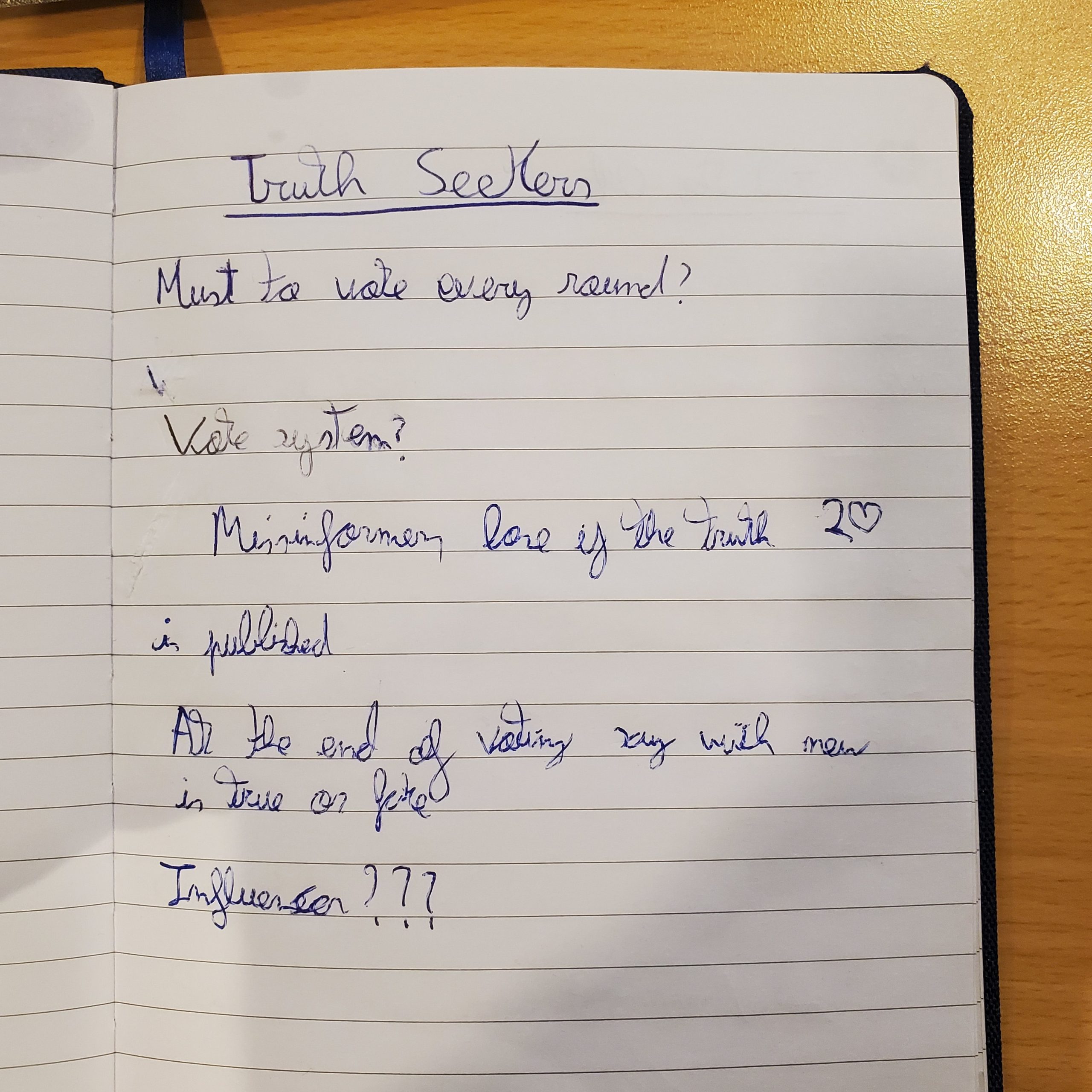
After a long brainstorm we finally hit with the idea of the rol card game, but we didnt knew how the mechanics of the game will work in real cases. So we played some games in class and note all that is missing to make it more confortable to play. This feedback helped us a lot to figure out what works and what don’t.
How to play Truth Seekers
SETUP
Roles are assigned secretly
📰 Journalist: must vote for the true news story.
❌ Misinformer: tries to convince others that the fake news is real.
📱 Influencer: from round two, can discover someone’s role.
PHASE 1
The Town sleeps
All players close their eyes. Misinformers open their eyes to see which story is true (revealed by the narrator).
PHASE 2
News Presentation
The narrator reads two headlines: one true, one fake. And players discuss which headline seems more credible in 3–5 minutes.
PHASE 3
Voting
Players vote on which news story they believe is true.
PHASE 4
Repeat
When the Town sleeps again the Influencer can see the role of someone. And the game continues the same.
END
Reveal and Outcome
The narrator reveals which news were real and discloses everyone’s roles
References
Bogost, I. (2011). How to do things with videogames. University of Minnesota Press.
Buckingham, D. (2015). The media education manifesto. Polity Press.
Gee, J. P. (2003). What video games have to teach us about learning and literacy. Palgrave Macmillan.
Mellado, C. (2015). Professional roles in news content: Six dimensions of journalistic role performance. Journalism Studies, 16(4), 596–614. https://doi.org/10.1080/1461670X.2014.922276
Newman, N., Fletcher, R., Robertson, C. T., Eddy, K., & Nielsen, R. K. (2023). Reuters Institute Digital News Report 2023. Reuters Institute for the Study of Journalism.
Sicart, M. (2014). Play matters. MIT Press.